Home/ Blog/ Payroll/ Payroll Management for Small Businesses
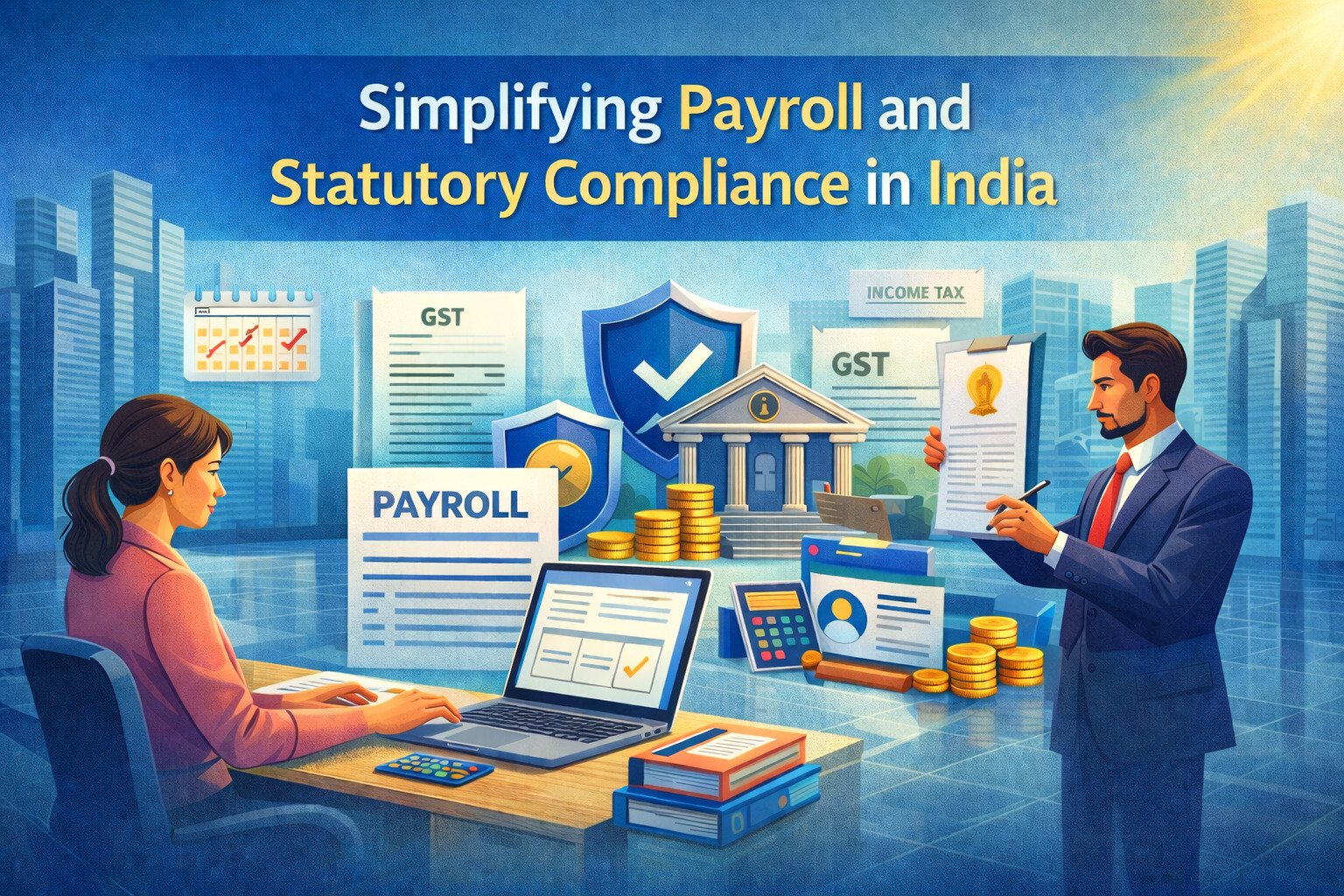
Payroll Management for Small Businesses in India: A Complete Guide
PF, ESIC, TDS on salary, professional tax, payslips, and the full compliance calendar — everything a small business owner needs to run payroll without missing a deadline.
Payroll management is one of the most legally complex and operationally demanding functions that a small business in India must handle. Unlike in many other countries where payroll is primarily a matter of calculating salary and transferring funds, Indian payroll involves a layered stack of statutory obligations: Employees' Provident Fund (PF), Employees' State Insurance (ESIC), Tax Deducted at Source (TDS) on salary, professional tax, the Payment of Wages Act, the Minimum Wages Act, the Gratuity Act, the Maternity Benefit Act, and state-level labour regulations. Missing a deadline or miscalculating a contribution can result in penalties, interest, employee grievances, and regulatory scrutiny.
For a small business owner managing payroll alongside running operations, sourcing, customer service, and everything else that demands attention, the payroll calendar alone — with its monthly, quarterly, and annual deadlines across multiple portals and authorities — can feel overwhelming. This guide breaks down everything a small business in India needs to know about payroll management: what's required, when it's due, how to structure salaries, what the penalties are for non-compliance, and how professional payroll management can reduce the burden while ensuring your business stays fully compliant.
What Does Payroll Management Involve for a Small Business in India?
Payroll management for a small business in India encompasses far more than running a monthly salary payment. It is a continuous cycle of calculation, deduction, deposit, record-keeping, and reporting that spans multiple authorities and touches every employee in the organisation. The payroll function includes:
- Salary calculation: Computing gross salary based on attendance, leave, overtime, and the agreed salary structure for each employee.
- Statutory deductions: Calculating and deducting Employee PF contribution (12% of basic), Employee ESIC contribution (0.75% of gross), TDS on salary (as per applicable tax slab), and professional tax (where applicable by state).
- Employer contributions: Computing and recording the employer's share of PF (12% of basic plus administrative charges), ESIC (3.25% of gross), and making provision for gratuity.
- Net salary computation: Arriving at the net take-home after all deductions and processing salary transfers to employee bank accounts.
- Payslip generation: Issuing monthly payslips to each employee showing gross earnings, all deductions, and net pay — a legal requirement and an employee right.
- Statutory deposits: Depositing PF, ESIC, TDS, and professional tax to the respective authorities by their specific due dates each month.
- Returns and filings: Filing monthly ECR (Electronic Challan cum Return) for PF, monthly ESIC return, quarterly TDS return (Form 24Q), and annual Form 16 to each employee.
- Record maintenance: Maintaining payroll registers, attendance records, statutory registers, and all filing acknowledgements — accessible to labour inspectors and tax authorities.
Each of these tasks has specific rules, specific deadlines, and specific consequences for non-compliance. Understanding the complete picture is the first step to managing payroll without costly errors.
When Do PF and ESIC Become Mandatory — and What Are the Contribution Rates?
The two pillars of statutory employee benefits in India are the Employees' Provident Fund (EPF) under the Employees' Provident Funds and Miscellaneous Provisions Act 1952, and the Employees' State Insurance (ESIC) under the Employees' State Insurance Act 1948. Both have specific applicability thresholds that small businesses must monitor:
| Statute | Threshold for Applicability | Employee Contribution | Employer Contribution | Wage Ceiling |
|---|---|---|---|---|
| Employees' Provident Fund (EPF) | 20 or more employees | 12% of basic + DA | 12% of basic + DA (+ 0.5% admin charges) | Mandatory on wages up to ₹15,000/month; voluntary above |
| Employees' State Insurance (ESIC) | 10 or more employees (in most states) | 0.75% of gross wages | 3.25% of gross wages | Applicable on wages up to ₹21,000/month gross |
Several important nuances deserve attention. For PF, the 12% contribution is calculated on basic salary + dearness allowance (DA) — not on total CTC or gross salary. A business that structures salaries with a low basic and high allowances (to minimise PF liability) must ensure this is genuine and not a deliberate circumvention, as EPFO officers are vigilant about such structures. Once an establishment is registered for PF, it remains covered even if employee count falls below 20.
For ESIC, the ₹21,000 gross wage ceiling means that employees earning above ₹21,000 per month are excluded from ESIC. However, once an employee's wages cross ₹21,000 mid-year (for instance, due to an increment during the contribution period of April–September or October–March), ESIC contributions continue for the rest of that contribution period and the employee becomes excluded from the next contribution period if they continue to earn above the ceiling.
How Should a Small Business Structure Employee Salaries to Be Tax-Efficient?
The structure of an employee's salary determines how much income tax they pay, how much PF is deducted, and how cost-effective the total compensation is for the employer. A well-designed salary structure aligns tax efficiency for the employee with cost management for the employer. The table below shows the typical components of an Indian salary structure and their tax treatment:
| Component | Typical % of CTC | Tax Treatment | Notes |
|---|---|---|---|
| Basic Salary | 35–50% | Fully taxable | PF calculated on Basic + DA |
| Dearness Allowance (DA) | 0–10% | Fully taxable | Common in government/PSU; less in private SMEs |
| House Rent Allowance (HRA) | 20–40% | Partially exempt u/s 10(13A) | Exempt: least of actual HRA, 50%/40% of basic, or rent paid minus 10% basic |
| Special Allowance | 10–20% | Fully taxable | Flexible component — often used to fill CTC |
| Leave Travel Allowance (LTA) | 5–8% | Exempt on actual travel (twice in 4 years) | Block year concept — proof required |
| Medical Allowance | ~2% | Taxable (separate reimbursement is tax-free up to ₹15,000) | Only reimbursement is exempt, not fixed allowance |
| Provident Fund (employer) | 12% of Basic | Exempt from tax (up to ₹7.5L in PF + NPS + superannuation combined) | Employer PF contribution part of CTC |
| Gratuity | ~4.8% of Basic | Tax-free up to ₹20L on separation | Accrues from day 1; payable after 5 years |
| Performance Bonus | Variable | Fully taxable in year of receipt | Timing of taxation: when accrued or paid — must be consistent |
For small businesses, the most practically important aspects of salary structure are: keeping basic salary at a level that is meaningful (minimum 35–40% of CTC is a reasonable benchmark) while managing PF liability; using HRA effectively for employees who live in rented accommodation; and structuring the reimbursement-based components (telephone, fuel, meal) as genuine reimbursements against bills rather than fixed allowances, since only the former are tax-efficient.
With the new income tax regime (effective from FY 2023-24 as the default), most allowance exemptions (HRA, LTA, etc.) are not available — employees opting for the new regime benefit from a flat standard deduction of ₹75,000 but lose most of the itemised exemptions. This has significant implications for salary structure design: businesses should ensure their payroll systems can handle both old and new regime calculations, as different employees may make different elections.
How Does TDS on Salary Work Under Section 192 — What Must Small Business Employers Do?
TDS (Tax Deducted at Source) on salary under Section 192 of the Income Tax Act 1961 is an employer's obligation — not optional, not delegated to the employee. The employer is responsible for correctly estimating each employee's annual income, computing the applicable tax, and deducting it monthly from salary payments. The process works as follows:
- 1. Collect Investment Declarations — At the start of each financial year (April), collect investment declarations (Form 12BB) from all employees. This includes their rent payments (for HRA), planned tax-saving investments (80C — PF, PPF, ELSS, LIC; 80D — health insurance; 80G — donations; etc.), home loan interest, and their regime choice (old or new). Without these declarations, the employer must compute TDS on the maximum possible tax liability.
- 2. Compute Annual Taxable Income — Based on the salary structure and declarations, compute each employee's estimated annual gross salary, apply applicable exemptions (if old regime), arrive at gross total income, apply chapter VI-A deductions, and compute taxable income. Apply the applicable slab rates (old or new regime as declared).
- 3. Monthly TDS Deduction — Divide the annual estimated tax liability by 12 (or by the remaining months of the year for mid-year joiners). Deduct this amount from each monthly salary payment. Adjust the monthly deduction as investment proofs are collected and the year-end position becomes clearer — the final months' deductions often need to be higher if under-deducted earlier.
- 4. Deposit TDS by 7th of Following Month — Deposit the TDS deducted to the government's account by the 7th of the month following the month of deduction. For the month of March, the deadline is 30 April. Deposits are made via Challan 281 (for company employers) or Challan 280 (for non-company employers). Use NSDL or income tax portal for online deposit.
- 5. File Quarterly TDS Return (Form 24Q) — File Form 24Q for each quarter: Q1 by 31 July, Q2 by 31 October, Q3 by 31 January, Q4 by 31 May. Form 24Q contains details of all employees' TDS deductions for the quarter, PAN numbers, salary amounts, and deposit challans. Accurate filing is critical — errors in Form 24Q lead to TDS credit mismatches in employees' Form 26AS.
- 6. Issue Form 16 by 15 June — After the close of the financial year, issue Form 16 to every employee by 15 June. Form 16 has two parts: Part A (generated from TRACES, showing TDS deposited quarter-wise) and Part B (salary details and tax computation). Form 16 is the employee's primary document for filing their own ITR — any errors in Form 16 directly affect the employee's tax return.
What Is Professional Tax and Which Small Businesses in India Must Pay It?
Professional tax (PT) is a state-level direct tax on salaried employees and self-employed professionals. It is levied by the state government under Article 276 of the Indian Constitution. The maximum PT payable is ₹2,500 per person per year (constitutionally capped). Despite the name, it applies to all salaried employees — not just professionals.
Professional tax is deductible from the employee's salary and deposited by the employer to the state authority. It is also a deductible expense from the employee's taxable salary for income tax purposes. The states that levy professional tax include: Maharashtra, Karnataka, West Bengal, Andhra Pradesh, Telangana, Gujarat, Tamil Nadu, Madhya Pradesh, Assam, and several northeastern states. States that do not levy professional tax include Delhi, Rajasthan, Uttar Pradesh, Haryana, and Punjab.
The compliance requirement for PT varies by state: in Maharashtra, PT is deposited monthly with an annual return; in Karnataka, there is a separate registration for each place of business and PT is paid monthly; in West Bengal, PT is typically semi-annual. Small businesses operating in PT-applicable states must register for professional tax, deduct it from employee salaries based on the state's slab rates, and file returns as per state-specific timelines.
What Is the Complete Payroll Compliance Calendar for Indian Small Businesses?
The table below provides a comprehensive monthly, quarterly, and annual compliance calendar for payroll management in India:
| Compliance | Frequency | Due Date | Portal / Authority |
|---|---|---|---|
| PF Contribution Payment | Monthly | 15th of following month | EPFO Unified Portal |
| ESIC Contribution Payment | Monthly | 15th of following month | ESIC Portal |
| TDS Deduction (Salary — 192) | Monthly | Deduct at time of payment | Employer obligation |
| TDS Deposit | Monthly | 7th of following month (30 Apr for Mar) | TIN-NSDL / Income Tax Portal |
| Professional Tax (state-specific) | Monthly / Annual | Varies by state (typically monthly by 15th) | State PT Authority |
| PF Monthly Return (ECR) | Monthly | Within 25 days of month-end | EPFO — Electronic Challan cum Return |
| ESIC Monthly Return | Monthly | Within 15 days of month-end | ESIC Portal |
| TDS Quarterly Return (24Q) | Quarterly | Q1: 31 Jul | Q2: 31 Oct | Q3: 31 Jan | Q4: 31 May | TRACES / TIN-NSDL |
| Form 16 / 16A Issuance | Annual | By 15 June of following FY | Generated via TDS reconciliation |
| PF Annual Return | Annual | 30 April of following FY | EPFO Portal |
| Labour Welfare Fund (LWF) | Half-yearly / Annual | Varies by state | State Labour Commissioner |
| Payroll Register Maintenance | Ongoing | Must be available at all times | Internal HR/Accounts records |
The most critical dates are the 15th of each month (PF and ESIC deposits), the 7th of each month (TDS deposit), and the quarterly TDS return dates. Missing these triggers automatic interest and penalty calculations. N D Savla & Co. tracks all payroll compliance deadlines for its clients and ensures no date is missed — including state-specific PT due dates which vary from business to business depending on the state of operation.
What Are the Penalties for Payroll Non-Compliance in India?
Payroll non-compliance in India attracts substantial penalties, interest, and in some cases criminal prosecution. The table below sets out the principal consequences:
| Violation | Penalty / Consequence | Relevant Law |
|---|---|---|
| Late PF deposit | Interest @ 12% p.a. + damages from 5% to 25% depending on delay period | EPF Act 1952, Para 38 |
| Non-registration for PF (threshold met) | Prosecution + arrears + penalty | EPF Act 1952, Section 14 |
| Late ESIC deposit | Interest @ 12% p.a. + penalty up to 25% of arrears | ESI Act 1948, Section 85-B |
| TDS non-deduction / short deduction | Penalty equal to amount of TDS not deducted | Income Tax Act, Section 271C |
| Late TDS deposit | Interest @ 1.5% per month from date of deduction to date of deposit | Income Tax Act, Section 201(1A) |
| Late TDS return (24Q) | ₹200 per day of delay up to amount of TDS; minimum ₹200/day | Income Tax Act, Section 234E |
| Non-issuance of Form 16 | Penalty of ₹100 per day of default | Income Tax Act, Section 272A |
| Professional Tax default | Penalty and interest (varies by state); potential for prosecution | State PT Acts |
| Late payment of wages | Employer liable under Payment of Wages Act; compensation to employee | Payment of Wages Act 1936 |
The cumulative effect of payroll penalties can be severe for a small business. A company that misses PF deposits for six months can face interest at 12% plus damages of up to 25% — effectively paying 37% extra on the arrears. TDS interest runs at 1.5% per month from the date of deduction, meaning a delay of even a few months on a significant TDS amount quickly becomes material. And the reputational impact with employees — who may see their PF credits not reflecting in their UAN passbook — can cause serious staff relations issues.
What Payroll Records Must a Small Business Maintain in India?
Indian labour laws and tax laws collectively require small businesses to maintain extensive payroll records. These must be available for inspection by EPFO officers, ESIC inspectors, income tax survey parties, and labour inspectors at any time. The key records are:
- Register of Wages: Under the Payment of Wages Act — must show each employee's gross wages, deductions (with category and amount), and net wages paid, maintained month-by-month.
- Attendance Register: Daily attendance record for all employees — must capture leave, overtime, half-days. Basis for wage calculation and labour compliance.
- PF Registers and ECR receipts: Monthly ECR (Electronic Challan cum Return) filed on EPFO portal, along with challan receipts for PF deposit. Must be preserved for at least 5 years.
- ESIC contribution records: Monthly contribution details and deposit challans. ESIC also requires periodic verification of insured persons' data.
- TDS deduction records: Month-wise TDS deduction schedule per employee, quarterly Form 24Q acknowledgements, and Form 16 copies issued to each employee.
- Salary slips: Individual monthly payslips for each employee — legally required and employee right. Must show all components and deductions clearly.
- Professional tax records: PT deduction and deposit records, state PT registration certificate, and return acknowledgements.
- Employment records: Offer letters, appointment letters, salary revision letters, and PF nomination forms (Form 2) for each employee.
Record maintenance is not just a legal obligation — it is the foundation for resolving any dispute with an employee, authority, or auditor. Businesses that cannot produce payroll records during an EPFO or income tax inspection face adverse presumptions that are very difficult to overturn.
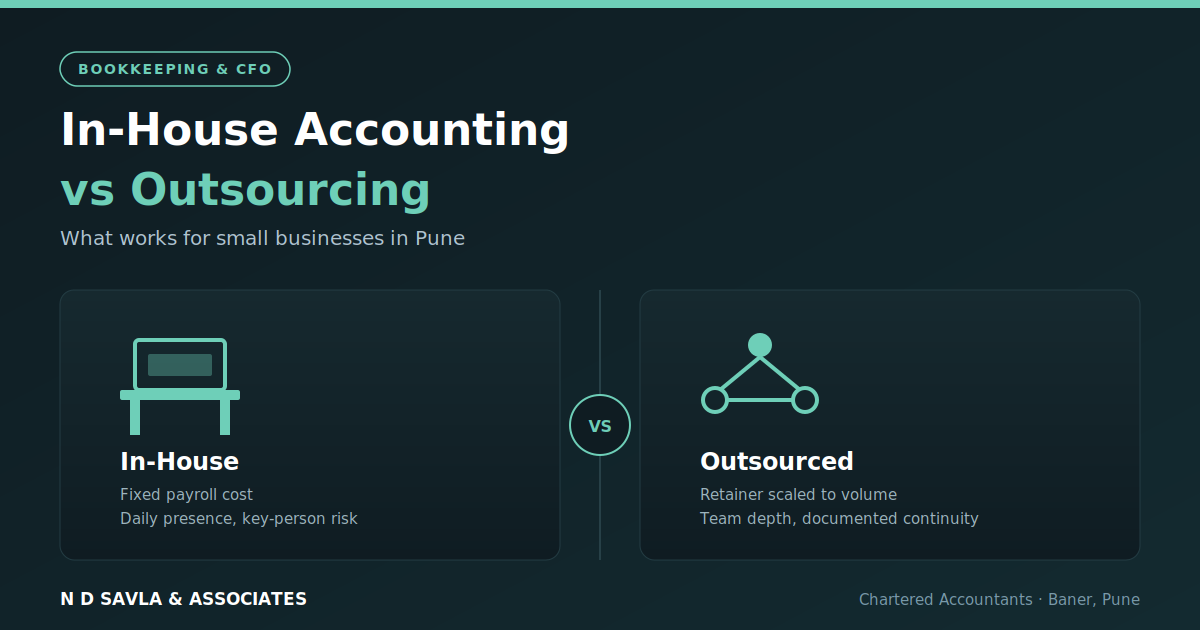
Should a Small Business Handle Payroll In-House or Outsource It?
For most small businesses in India — those with fewer than 50 employees — outsourcing payroll to a professional firm is significantly more cost-effective and reliable than managing it in-house. Here is why:
- 1. Compliance Expertise — Payroll compliance in India spans at least four distinct laws (EPF Act, ESI Act, Income Tax Act, Payment of Wages Act) plus multiple state-level PT laws. A professional payroll firm has specialists in each area, stays current with regulatory changes (rate revisions, portal changes, new circulars), and maintains compliance calendars that ensure no deadline is missed.
- 2. Technology and Portal Access — EPFO's Unified Portal, ESIC's portal, TRACES for TDS, and state PT portals all have distinct login requirements, filing formats, and technical challenges. A professional payroll provider handles all portal interactions as part of the service — your business simply provides the monthly payroll inputs.
- 3. Error Reduction — Manual payroll calculation for even 10–15 employees involves dozens of calculations per employee — basic to PF, tax slab application, exemption computation, regime comparison. Errors in any of these flow through to multiple statutory filings. A professional firm uses validated payroll software and a review process that catches errors before they become filings.
- 4. Confidentiality — Sensitive payroll information — individual salaries, bonuses, increment history — benefits from being handled by a professional external party rather than by an in-house person who is also a colleague of the employees whose data they handle.
- 5. Cost Comparison — The cost of a professional payroll service for a 10–20 employee business in India typically ranges from ₹5,000–₹15,000 per month — significantly less than the cost of a dedicated in-house payroll person.
How Has Payroll Compliance in India Evolved for Small Businesses?
India's payroll compliance landscape has transformed dramatically over the past three decades. In the early 1990s, most small businesses maintained paper-based wage registers, physically deposited PF and ESIC contributions at post offices or banks with paper challans, and filed paper-based annual returns with the respective offices. Inspectors from EPFO and ESIC would visit establishments physically to verify records. The system was paper-intensive, relationship-dependent, and largely manual.
The digital transformation of India's labour compliance began in earnest in the 2010s. EPFO launched its Unified Portal and the Electronic Challan cum Return (ECR) system, moving monthly PF filings entirely online. The ESIC portal similarly went digital. TRACES (TDS Reconciliation Analysis and Correction Enabling System) was launched by CBDT to enable online TDS reconciliation and Form 16 generation. The UAN (Universal Account Number) system for PF — launched in 2014 — gave each employee a portable PF identity that stays with them across employers, making portability and online passbook access possible.
The Labour Codes consolidation — four Labour Codes that consolidate 29 central labour laws — represent the next wave of reform. The Wages Code 2019, Industrial Relations Code 2020, Social Security Code 2020, and Occupational Safety Code 2020 have been enacted but await state government implementation rules before they come into full effect. When implemented, these codes will significantly change the definition of wages used for PF and ESIC calculation, the threshold for PF applicability, and several labour compliance obligations. Businesses and their payroll advisors need to stay current with the implementation timeline and transition planning for the Labour Codes.
Frequently Asked Questions — Payroll Management for Small Businesses in India
Is PF mandatory for small businesses in India?
Yes, PF is mandatory for any establishment that employs 20 or more employees. Once an establishment crosses 20 employees, it must register with EPFO within 30 days and deduct 12% of basic salary + DA from employees and contribute an equal 12% from the employer side. Even if the employee count subsequently falls below 20, the establishment remains covered.
When does ESIC become mandatory for a small business?
ESIC is mandatory for establishments with 10 or more employees in most states (20 in some states) where employees earn gross wages of ₹21,000 per month or less. Employee contribution is 0.75% of gross wages and employer contribution is 3.25%. Establishments must register within 15 days of reaching the applicability threshold.
What is TDS on salary and how is it calculated for small business employees?
TDS on salary under Section 192 requires an employer to estimate each employee's annual salary income, deduct applicable exemptions and deductions, compute the annual tax liability, divide by 12, and deduct that amount monthly. The employer deposits TDS by the 7th of the following month, files quarterly Form 24Q returns, and issues Form 16 by 15 June after the financial year.
What is professional tax and which states charge it?
Professional tax is a state-level tax on salaried employees, capped at ₹2,500 per year. States that levy PT include Maharashtra, Karnataka, West Bengal, Andhra Pradesh, Telangana, Gujarat, Tamil Nadu, and others. States that do not include Delhi, Rajasthan, and Uttar Pradesh. Employers must register, deduct PT, and file returns as per state-specific rules.
What records must a small business maintain for payroll in India?
Small businesses must maintain: register of wages, attendance registers, PF ECR receipts and challans, ESIC contribution records, TDS deduction records and Form 24Q acknowledgements, salary slips for each employee and month, Form 16 copies, PT records, and employment documents. These must be preserved for at least 5 years and made available to inspecting authorities on demand.
Let N D Savla & Co. Manage Your Payroll Compliance
Payroll management is too important — and too compliance-heavy — to leave to chance or to an overloaded in-house resource who's also doing everything else. N D Savla & Co. provides comprehensive payroll management for small businesses across India: salary calculation, PF and ESIC registration and filings, TDS deduction and quarterly returns, Form 16 generation, professional tax compliance, and payroll register maintenance.
Our payroll services are priced on a per-employee retainer basis — transparent, scalable, and all-inclusive. Get in touch to discuss your payroll requirements and receive a quote.
Get in touch