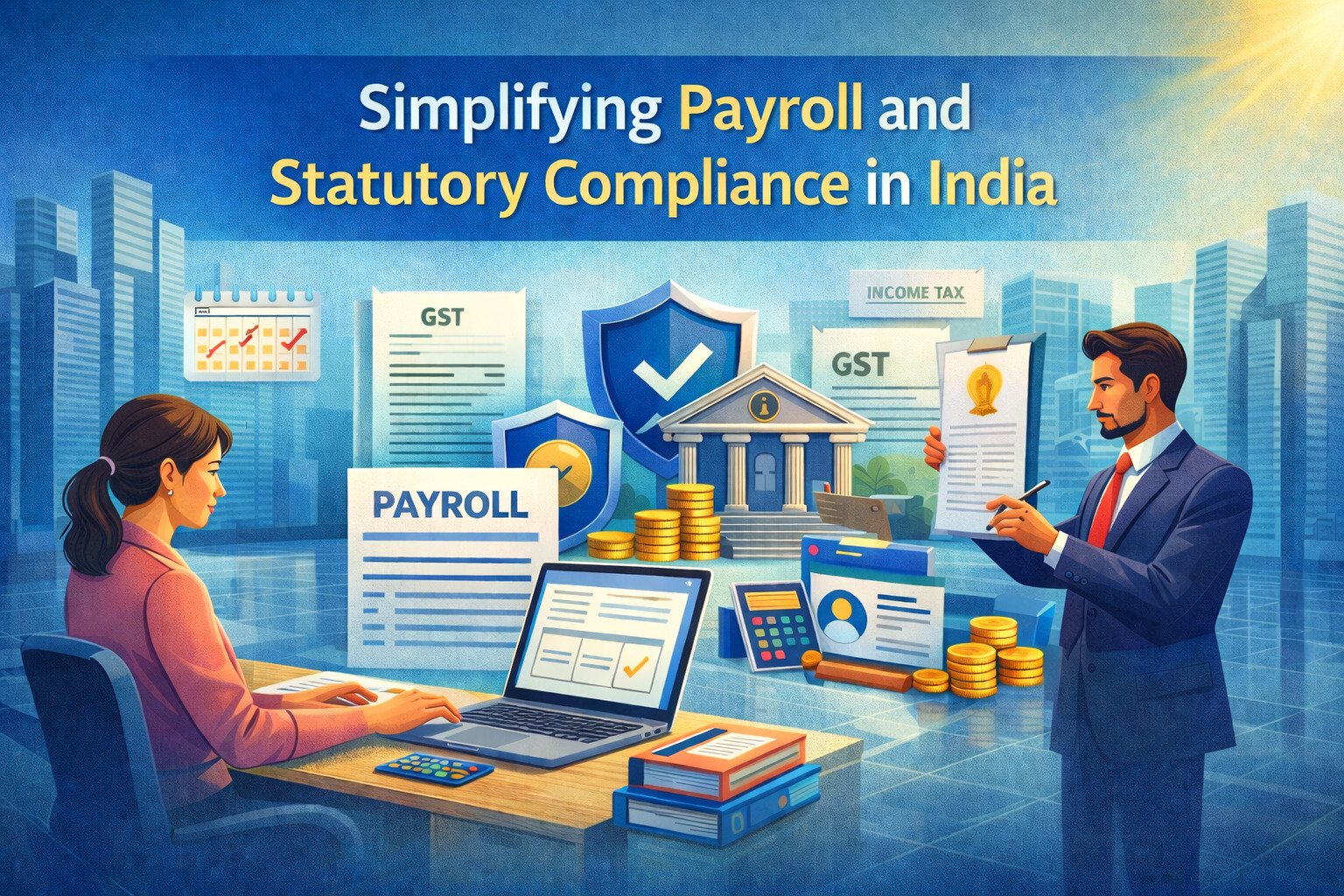
Payroll Management for Small Businesses in India: A Complete Guide | N D Savla & Co. N D Savla & Co. — Payroll, Accounting & Compliance Blog / Small Business Compliance Series N D Savla & Co. ndsavla.in Payroll Services Accounting Compliance Get a Quote Home/ Blog/ Payroll/ Payroll Management for Small Businesses Payroll / Small Business Compliance Payroll Management for Small Businesses in India: A Complete Guide PF, ESIC, TDS on salary, professional tax, payslips, and the full compliance calendar — everything a small business owner needs to run payroll without missing a deadline. N D Savla & Co. Published 08 September 2026 12–15 min read Payroll management is one of the most legally complex and operationally demanding functions that a small business in India must handle. Unlike in many other countries where payroll is primarily a matter of calculating salary and transferring funds, Indian payroll involves a layered stack of statutory obligations: Employees’ Provident Fund (PF), Employees’ State Insurance (ESIC), Tax Deducted at Source (TDS) on salary, professional tax, the Payment of Wages Act, the Minimum Wages Act, the Gratuity Act, the Maternity Benefit Act, and state-level labour regulations. Missing a deadline or miscalculating a contribution can result in penalties, interest, employee grievances, and regulatory scrutiny. For a small business owner managing payroll alongside running operations, sourcing, customer service, and everything else that demands attention, the payroll calendar alone — with its monthly, quarterly, and annual deadlines across multiple portals and authorities — can feel overwhelming. This guide breaks down everything a small business in India needs to know about payroll management: what’s required, when it’s due, how to structure salaries, what the penalties are for non-compliance, and how professional payroll management can reduce the burden while ensuring your business stays fully compliant. What Does Payroll Management Involve for a Small Business in India? Payroll management for a small business in India encompasses far more than running a monthly salary payment. It is a continuous cycle of calculation, deduction, deposit, record-keeping, and reporting that spans multiple authorities and touches every employee in the organisation. The payroll function includes: Salary calculation: Computing gross salary based on attendance, leave, overtime, and the agreed salary structure for each employee. Statutory deductions: Calculating and deducting Employee PF contribution (12% of basic), Employee ESIC contribution (0.75% of gross), TDS on salary (as per applicable tax slab), and professional tax (where applicable by state). Employer contributions: Computing and recording the employer’s share of PF (12% of basic plus administrative charges), ESIC (3.25% of gross), and making provision for gratuity. Net salary computation: Arriving at the net take-home after all deductions and processing salary transfers to employee bank accounts. Payslip generation: Issuing monthly payslips to each employee showing gross earnings, all deductions, and net pay — a legal requirement and an employee right. Statutory deposits: Depositing PF, ESIC, TDS, and professional tax to the respective authorities by their specific due dates each month. Returns and filings: Filing monthly ECR (Electronic Challan cum Return) for PF, monthly ESIC return, quarterly TDS return (Form 24Q), and annual Form 16 to each employee. Record maintenance: Maintaining payroll registers, attendance records, statutory registers, and all filing acknowledgements — accessible to labour inspectors and tax authorities. Each of these tasks has specific rules, specific deadlines, and specific consequences for non-compliance. Understanding the complete picture is the first step to managing payroll without costly errors. When Do PF and ESIC Become Mandatory — and What Are the Contribution Rates? The two pillars of statutory employee benefits in India are the Employees’ Provident Fund (EPF) under the Employees’ Provident Funds and Miscellaneous Provisions Act 1952, and the Employees’ State Insurance (ESIC) under the Employees’ State Insurance Act 1948. Both have specific applicability thresholds that small businesses must monitor: Statute Threshold for Applicability Employee Contribution Employer Contribution Wage Ceiling Employees’ Provident Fund (EPF) 20 or more employees 12% of basic + DA 12% of basic + DA (+ 0.5% admin charges) Mandatory on wages up to ₹15,000/month; voluntary above Employees’ State Insurance (ESIC) 10 or more employees (in most states) 0.75% of gross wages 3.25% of gross wages Applicable on wages up to ₹21,000/month gross Several important nuances deserve attention. For PF, the 12% contribution is calculated on basic salary + dearness allowance (DA) — not on total CTC or gross salary. A business that structures salaries with a low basic and high allowances (to minimise PF liability) must ensure this is genuine and not a deliberate circumvention, as EPFO officers are vigilant about such structures. Once an establishment is registered for PF, it remains covered even if employee count falls below 20. For ESIC, the ₹21,000 gross wage ceiling means that employees earning above ₹21,000 per month are excluded from ESIC. However, once an employee’s wages cross ₹21,000 mid-year (for instance, due to an increment during the contribution period of April–September or October–March), ESIC contributions continue for the rest of that contribution period and the employee becomes excluded from the next contribution period if they continue to earn above the ceiling. Note PF contribution is mandatory on wages up to ₹15,000 per month. For employees earning above ₹15,000, the employer must contribute at least on ₹15,000 (the statutory minimum), but may voluntarily contribute on the higher actual wages. Employees earning above ₹15,000 can also opt out of PF if they were not PF members at the time of joining — but this option is available only to new members, not to those already contributing. How Should a Small Business Structure Employee Salaries to Be Tax-Efficient? The structure of an employee’s salary determines how much income tax they pay, how much PF is deducted, and how cost-effective the total compensation is for the employer. A well-designed salary structure aligns tax efficiency for the employee with cost management for the employer. The table below shows the typical components of an Indian salary structure and their tax treatment: Component Typical % of CTC Tax Treatment Notes Basic Salary 35–50% Fully taxable PF calculated on