IFRS vs US GAAP: Key Differences Every Business and Finance Professional Must Know
Understand the critical differences between IFRS and US GAAP across revenue, leases, inventory, R&D, and impairment — and what they mean for Indian businesses.
IFRS vs US GAAP matters to Indian businesses in a way it did not a decade ago. India's adoption of Ind AS — converged with IFRS — means that Indian financial statements already follow IFRS principles. But the moment an Indian company becomes a subsidiary of a US multinational, lists on a US stock exchange, enters a cross-border acquisition, or operates a Global Capability Centre processing accounting for a US parent, the differences between IFRS and US GAAP become a daily operational reality. These differences are not theoretical — they change reported revenue, asset values, EBITDA, and net profit. An Indian pharmaceutical company that capitalises development costs of ₹50 crore under Ind AS (following IFRS) will report those costs as an expense under US GAAP, reducing its US GAAP profit by ₹50 crore in a single year. An Indian manufacturer using weighted average inventory will report different cost of goods sold if the US parent applies LIFO. An Indian company applying IFRS 16's single lease model will show different operating profit than the same company under ASC 842's dual model. N D Savla & Associates, a Chartered Accountant firm in Mumbai, provides accounting advisory services that cover both IFRS and US GAAP frameworks for Indian businesses operating in cross-border environments.
Why Does the IFRS vs US GAAP Comparison Matter Specifically for Indian Businesses?
The IFRS and GAAP comparison is not an academic exercise for Indian businesses — it affects four specific and increasingly common scenarios in the Indian corporate landscape.
Indian Subsidiaries of US Multinationals
Over 1,700 US multinational corporations operate subsidiaries in India. Every quarter, these Indian entities prepare US GAAP reporting packages that are used by the US parent for group consolidation and SEC reporting. The Indian subsidiary maintains its statutory books under Ind AS (converged with IFRS), but the reporting package must be converted to US GAAP — requiring identification and quantification of every Ind AS and US GAAP reconciliation adjustment. Revenue recognition timing differences, lease classification differences, development cost treatment, and inventory valuation methodology all generate conversion entries. The accuracy of these entries directly affects the US parent's consolidated financial statements, which are subject to SEC scrutiny, SOX compliance, and external audit.
Indian Companies Listed on US Exchanges
Indian companies listed on NASDAQ or NYSE — including technology, pharmaceutical, and financial services firms — file annual reports on Form 20-F with the SEC. Foreign private issuers may file using IFRS (as issued by the IASB) or US GAAP. If an Indian company files using IFRS, it must ensure compliance with pure IFRS — not Ind AS, which contains carve-outs. If it files using US GAAP, the full framework conversion from Ind AS to US GAAP must be executed to SEC standards.
Cross-Border M&A and Joint Ventures
When an Indian company acquires or merges with a US company — or vice versa — the due diligence process requires reconciliation of financial statements across frameworks. Purchase price allocation, earn-out calculations, and post-merger integration all depend on which framework's numbers are used. An asset valued at ₹100 crore under IFRS (where development costs are capitalised and impairment reversals are permitted) may be valued differently under US GAAP (where those costs are expensed and reversals are prohibited). Transfer pricing arrangements between Indian and US entities must also reference the correct framework's profitability metrics.
Global Capability Centres (GCCs) and Shared Service Centres
India hosts over 1,700 GCCs — captive centres that process finance, accounting, and reporting functions for global parent companies. A significant share of these GCCs process US GAAP accounting for US-headquartered groups. The Indian finance professionals staffing these centres must understand US GAAP rules — ASC codification, revenue recognition under ASC 606, lease accounting under ASC 842, credit loss provisioning under ASC 326 — even though their statutory Indian training is in Ind AS and IFRS. For CA firms advising GCC operations, competence in both frameworks is a competitive necessity.
How Do IFRS and US GAAP Differ in Their Approach to Standard-Setting and Professional Judgement?
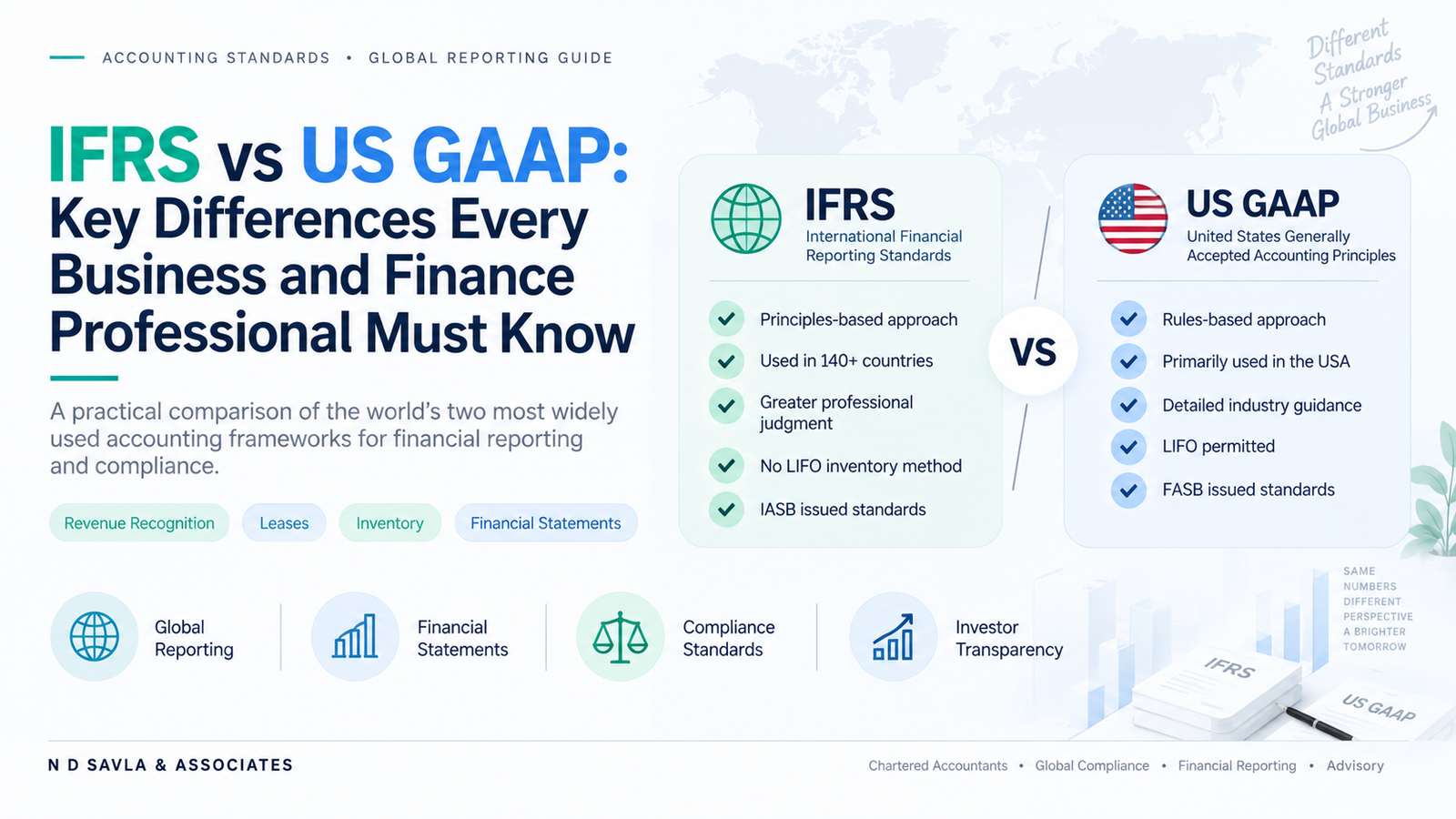
The most fundamental IFRS vs US GAAP difference is not about any single accounting treatment — it is about how the two frameworks approach the task of creating accounting rules. This philosophical difference shapes every standard, every application, and every audit under each framework.
IFRS, issued by the International Accounting Standards Board (IASB), is a principles-based framework. Standards establish broad principles and objectives, and preparers apply professional judgement to determine how those principles apply to specific transactions. When IAS 38 (Intangible Assets) requires capitalisation of development costs when six criteria are met — technical feasibility, intention to complete, ability to use or sell, existence of future economic benefits, availability of resources, and ability to measure expenditure reliably — the preparer must exercise judgement on whether each criterion is satisfied. There is no numerical threshold, no percentage test, and no bright-line rule. The auditor evaluates whether the preparer's judgement was reasonable, not whether a specific test was passed. The Institute of Chartered Accountants of India (ICAI) trains Indian CAs in this principles-based approach through the Ind AS framework.
US GAAP, issued by the Financial Accounting Standards Board (FASB), is a rules-based framework. The Accounting Standards Codification (ASC) provides detailed, specific guidance — including numerical thresholds, decision trees, and scope exceptions — for virtually every transaction type. Where IFRS says "exercise judgement," US GAAP says "apply this test." This reduces diversity in practice and provides legal defensibility in the litigation-heavy US environment, but it also enables structuring — designing transactions to meet or avoid specific thresholds without necessarily reflecting economic substance. The ASC runs to thousands of pages, compared to the relatively compact body of IFRS standards.
For Indian finance professionals, this difference affects daily work. An accountant preparing Ind AS (IFRS-based) financial statements documents the judgements applied and defends the economic rationale. An accountant preparing US GAAP statements locates the specific ASC paragraph, applies the prescribed test, and documents compliance with each criterion. When N D Savla & Associates advises clients on dual framework reporting through its audit and assurance practice, the team maintains separate methodology manuals for each framework — because the approach to reaching the answer, not just the answer itself, is different.
How Did India End Up Between IFRS and US GAAP — And Where Is the Global Landscape Headed?
India's position as an IFRS-converged jurisdiction with deep US economic ties places Indian businesses squarely at the intersection of the two frameworks. Understanding how the global standard-setting landscape evolved — and why full convergence stalled — provides essential context.
1973–2001 — Separate Origins, Parallel Development
FASB was established in 1973 to develop US accounting standards, building on decades of SEC guidance. In the same year, the International Accounting Standards Committee (IASC) was founded to develop standards for cross-border use. India's ICAI developed its own Accounting Standards (AS) drawing on IAS but adapted for Indian conditions. Through the 1990s, the three systems — US GAAP, IAS/IFRS, and Indian AS — developed independently, with minimal coordination. US GAAP became the world's most detailed framework, IAS/IFRS became the most widely adopted, and Indian AS served a domestic-only purpose. There was no pressing need for reconciliation because cross-border capital flows and multinational operations were limited relative to today.
2002–2014 — The Convergence Promise and Partial Delivery
The 2002 Norwalk Agreement between the IASB and FASB launched the most ambitious convergence programme in accounting history. The two boards committed to eliminating differences and developing new standards jointly. This programme produced two landmark results: revenue recognition (IFRS 15 and ASC 606, substantially converged) and lease accounting (IFRS 16 and ASC 842, partially converged). India, watching from the sidelines, decided to converge with IFRS rather than US GAAP — a strategic choice that aligned Indian financial reporting with the framework adopted by over 140 countries rather than the one used exclusively by the United States. The MCA notified Ind AS in 2015, with mandatory adoption beginning in 2016.
2014 to Present — Coexistence, Not Convergence
After 2014, the IASB-FASB convergence programme effectively ended. The SEC never mandated IFRS for US domestic issuers. Material differences remained — and new differences emerged as each board issued standards independently (IFRS 9 vs ASC 326 on credit losses, IFRS 16 vs ASC 842 on lease expense patterns). India, having committed to IFRS convergence through Ind AS, found itself in a position where its domestic framework (Ind AS) was aligned with IFRS but not with US GAAP — creating a permanent need for Ind AS and US GAAP reconciliation whenever Indian businesses interact with US counterparts. The Ministry of Corporate Affairs continues to align Ind AS with new IFRS standards as they are issued, further embedding the IFRS orientation in Indian financial reporting.
What Are the IFRS vs US GAAP Differences That Most Affect Reported Financial Statements?
The IFRS vs US GAAP differences can be organised by their impact on the three primary financial statements — profit or loss, the balance sheet, and the cash flow statement. This grouping helps business owners and finance professionals understand where the numbers will change when moving between frameworks.
Differences That Primarily Affect Reported Profit:
Development Costs (IAS 38 vs ASC 730): Under IFRS, development expenditure is capitalised as an intangible asset when six criteria are met, then amortised over its useful life. Under US GAAP, all R&D costs are expensed immediately (with narrow exceptions for software). Impact: IFRS reports higher profit in the development phase (costs capitalised) and lower profit in the amortisation phase. US GAAP reports lower profit during development (costs expensed) and higher profit later (no amortisation). For an Indian IT company spending ₹30 crore annually on product development, this single difference can swing reported profit by ₹20 crore or more depending on the capitalisation and amortisation profile.
Lease Expense Pattern (IFRS 16 vs ASC 842): Under IFRS 16, all leases generate a front-loaded expense pattern — depreciation of the right-of-use asset plus interest on the lease liability. Under ASC 842, operating leases generate straight-line expense. Finance leases under both frameworks are front-loaded. The impact is that IFRS shows higher expense in early lease years and lower expense in later years compared to US GAAP for operating leases. For a company with a large operating lease portfolio (retail chains, airlines, co-working operators), EBITDA under IFRS is higher than under US GAAP because IFRS reclassifies the lease expense below EBITDA, while US GAAP's straight-line operating lease expense remains above EBITDA.
Impairment Reversals (IAS 36 vs ASC 360): IFRS permits the reversal of impairment losses on assets other than goodwill when conditions improve. US GAAP prohibits all impairment reversals. Impact: under IFRS, a company that wrote down a manufacturing plant by ₹10 crore can reverse that write-down (up to the original carrying amount) if market conditions recover. Under US GAAP, the ₹10 crore write-down is permanent. This creates a one-directional asymmetry — IFRS profits can recover from impairments, US GAAP profits cannot.
Differences That Primarily Affect the Balance Sheet:
Inventory Valuation (IAS 2 vs ASC 330): IFRS prohibits LIFO; US GAAP permits it. Additionally, IFRS allows reversal of inventory write-downs while US GAAP does not. These differences directly affect the inventory line on the balance sheet and the cost of goods sold in the income statement. A US parent using LIFO may carry inventory at significantly lower values than the IFRS equivalent, and the LIFO reserve (the difference between LIFO and FIFO inventory values) can be material for companies with large physical inventories.
Revaluation of PPE and Intangibles (IAS 16/38 vs ASC 360): IFRS permits the revaluation model for property, plant, and equipment and intangible assets — carrying them at fair value with changes in OCI. US GAAP requires the cost model only — assets are carried at historical cost less accumulated depreciation and impairment. For Indian real estate companies, hospitality groups, and infrastructure firms with appreciating physical assets, this difference means that IFRS balance sheets show higher asset values and stronger equity ratios than US GAAP equivalents.
Differences That Affect Cash Flow Classification:
IFRS provides flexibility in classifying interest paid (operating or financing), dividends paid (operating or financing), and interest and dividends received (operating or investing). US GAAP prescribes fixed classifications: interest paid is operating, dividends paid is financing, and interest and dividends received are operating. This means that two identical companies with identical transactions can report different operating cash flow figures depending on whether they report under IFRS or US GAAP — even though total cash flow remains the same. Investors comparing operating cash flow between IFRS and US GAAP companies must adjust for these classification differences. Companies using CFO services for management reporting and investor communication benefit from advisory that reconciles these classification differences in dual-framework presentations.
📋 Note: India's Ind AS is converged with IFRS, so Indian companies already follow IFRS principles — including the prohibition on LIFO, the capitalisation of qualifying development costs, the single lessee model for leases, and the permission to reverse impairments. When an Indian company prepares US GAAP reporting packages, the conversion adjustments run from Ind AS (IFRS-based) to US GAAP. The most common adjustments relate to development cost reversal, lease expense reclassification, and inventory write-down reversal prohibition.
⚠️ Important: Mixing IFRS and US GAAP treatments in a single set of financial statements — even inadvertently — produces financial statements that comply with neither framework and constitutes a material misstatement. This risk is highest in Indian companies that maintain books under Ind AS but prepare US GAAP reporting packages by applying conversion adjustments: if a conversion entry is missed, the US GAAP output inherits the IFRS treatment for that item. Every conversion workbook must be reviewed against a complete difference register, and both the Ind AS and US GAAP outputs must be independently verified for internal consistency.
What Are the Steps to Build a Dual IFRS and US GAAP Reporting Capability for an Indian Company?
For Indian companies that face ongoing US GAAP reporting obligations — whether for a US parent, a US listing, or a GCC — building a sustainable dual-reporting capability is more valuable than treating each period's conversion as a one-off exercise. The following steps outline the approach that N D Savla & Associates recommends.
- Create a Comprehensive IFRS-to-US-GAAP Difference Register — Map every accounting policy in the company's Ind AS financial statements against the equivalent US GAAP treatment. For each area — revenue, leases, inventory, intangibles, employee benefits, financial instruments, provisions, income taxes, consolidation — document whether the Ind AS and US GAAP treatments are identical, similar with quantifiable differences, or fundamentally different. The output is a master difference register that serves as the reference for every subsequent reporting period. This register must be maintained and updated as both frameworks evolve — new IFRS or US GAAP standards can create new differences or eliminate existing ones.
- Design a Dual-Purpose Chart of Accounts and Data Architecture — Rather than maintaining two separate sets of books, design a chart of accounts that captures the data needed for both frameworks at the transaction level. For example, classify development costs in a way that allows them to be capitalised under Ind AS while simultaneously tracking the amount that must be expensed under US GAAP. Tag leases with the information needed for both IFRS 16 (single model) and ASC 842 (dual model) calculations. This upfront investment in data architecture eliminates the need for manual reconstruction of transaction-level data during the conversion process. Companies setting up new operations benefit from business registration and structuring advice that accounts for dual-reporting requirements from Day 1.
- Automate Recurring Conversion Adjustments — Many IFRS-to-US-GAAP differences generate the same type of conversion entry every period — development cost reversal, lease expense reclassification, inventory write-down reversal prohibition. Build these recurring adjustments into the monthly close process rather than computing them at year-end. Spreadsheet-based or ERP-based templates that automatically calculate the adjustment based on the underlying data reduce manual effort and error. For a company with 15 recurring conversion entries, automating these entries saves 40 to 60 hours per quarter and improves accuracy.
- Establish Conversion Review and Sign-Off Controls — Every conversion entry must be reviewed by a senior accountant or CA who understands both frameworks. The reviewer verifies that the difference register is current, that the conversion entries are mathematically correct, that the resulting US GAAP financial statements are internally consistent (the balance sheet balances, the cash flow ties to the change in cash, the statement of changes in equity reconciles), and that the disclosures are appropriate for the target framework. This review is distinct from the statutory audit of the Ind AS financial statements — it is a separate quality control step for the US GAAP output. Professional audit and assurance teams with dual-framework expertise perform this review more effectively than generalist accountants.
- Train the Finance Team on Both Frameworks — The finance team members who prepare the conversion entries must understand not just the mechanics of each adjustment but the underlying standard that drives it. A bookkeeper who posts the development cost reversal entry without understanding why IAS 38 and ASC 730 differ will struggle to handle non-routine transactions — a new development project, an impairment of a capitalised asset, or a change in the useful life estimate. Invest in training that covers the conceptual basis of each major difference, not just the journal entry template. CA firms that provide ongoing advisory include periodic training sessions as part of the engagement.
- Monitor Standard Changes and Update the Process Continuously — Both the IASB and FASB continue to issue new and amended standards. Each change must be evaluated for its impact on the dual-reporting process — does it create a new difference, eliminate an existing one, or change the magnitude of a current adjustment? Assign responsibility for monitoring IASB and FASB updates, assessing the impact, and updating the difference register, chart of accounts, and conversion templates. Companies that engage N D Savla & Associates for ongoing accounting advisory receive proactive alerts when standard changes affect their dual-reporting process, ensuring that the conversion methodology stays current.
How Do IFRS vs US GAAP Differences Affect Company Valuations and Cross-Border Deals?
The IFRS vs US GAAP differences are not just accounting technicalities — they directly affect how companies are valued in M&A transactions, equity fundraising, and credit assessments. For Indian companies involved in cross-border deals with US counterparts, understanding these valuation implications is as important as understanding the accounting rules themselves.
The most direct impact is on EBITDA-based valuations. When an acquirer values a target company using an EBITDA multiple, the IFRS and US GAAP EBITDA figures for the same company can differ materially. Under IFRS 16, operating lease payments are excluded from EBITDA (they are split into depreciation and interest below the EBITDA line), inflating EBITDA relative to US GAAP, where operating lease expense remains above the EBITDA line under ASC 842. A retail company with ₹20 crore in annual lease payments will show ₹20 crore higher EBITDA under IFRS than under US GAAP. At an 8x EBITDA multiple, this single difference translates to a ₹160 crore valuation differential — a swing that can make or break a deal.
Development cost capitalisation creates a similar effect. An Indian biotech company that capitalises ₹40 crore of development costs under Ind AS reports EBITDA that is ₹40 crore higher than its US GAAP equivalent (where those costs are expensed). The valuation impact at any reasonable multiple is hundreds of crores. Acquirers and investors who do not adjust for framework differences risk overpaying or underpaying based on inflated or deflated metrics.
For Indian companies being acquired by US buyers, the due diligence process typically requires a "quality of earnings" analysis that restates the target's Ind AS earnings to US GAAP. This restatement identifies the sustainable, recurring earnings under the acquirer's reporting framework and strips out framework-driven differences. A CA firm with expertise in both frameworks — such as N D Savla & Associates — plays a critical role in preparing or reviewing these quality-of-earnings analyses. Similarly, Indian companies acquiring US targets need the reverse analysis: restating US GAAP to Ind AS for the purpose of assessing how the acquisition will affect the Indian group's consolidated financial statements. Companies navigating these transactions also rely on tax services and GST compliance support to address the tax implications of cross-border restructurings that arise alongside the accounting conversion.
Frequently Asked Questions About IFRS vs US GAAP
What are the main differences between IFRS and US GAAP?
The main differences between IFRS and US GAAP span six critical areas. Inventory: IFRS prohibits LIFO while US GAAP permits it. Development costs: IFRS requires capitalisation when criteria are met while US GAAP expenses all R&D. Leases: IFRS 16 uses a single lessee model while ASC 842 retains operating vs finance lease distinction for lessees. Impairment: IFRS allows reversal of asset impairments (except goodwill) while US GAAP prohibits reversals. Financial instruments: IFRS 9 uses a three-stage expected credit loss model while US GAAP's CECL model requires immediate lifetime loss recognition. Conceptual approach: IFRS is principles-based with fewer bright-line rules while US GAAP is rules-based with specific numerical thresholds and detailed application guidance.
Does India follow IFRS or US GAAP?
India follows Ind AS (Indian Accounting Standards), which is converged with IFRS — not identical to it and not related to US GAAP. Ind AS was notified by the Ministry of Corporate Affairs under the Companies Act, 2013 and includes specific carve-outs from pure IFRS to suit Indian legal and economic conditions. Indian companies listed on US stock exchanges or with US parent companies may additionally need to prepare US GAAP financial statements for SEC filing or group consolidation. The Ind AS and US GAAP reconciliation process requires identifying and quantifying every difference between the two frameworks for each affected line item.
Why do Indian companies need to understand US GAAP?
Indian companies encounter US GAAP in several practical scenarios: Indian subsidiaries of US multinationals prepare quarterly US GAAP reporting packages for group consolidation; Indian companies listed on NASDAQ or NYSE file US GAAP or IFRS financial statements with the SEC; cross-border M&A transactions require financial due diligence under both frameworks; Global Capability Centres (GCCs) in India process US GAAP accounting for parent companies; and Indian IT, pharma, and manufacturing companies with significant US operations must reconcile between Ind AS and US GAAP for management reporting. A CA firm for IFRS and US GAAP India that understands both frameworks serves these clients more effectively.
Will IFRS and US GAAP ever fully converge?
Full convergence between IFRS and US GAAP appears unlikely in the foreseeable future. While the IASB and FASB achieved significant alignment on revenue recognition (IFRS 15 and ASC 606) and lease accounting (IFRS 16 and ASC 842) through joint standard-setting projects, the convergence programme has stalled since 2014. The SEC has not mandated IFRS adoption for US domestic issuers, and fundamental differences persist in areas like inventory (LIFO), development costs, impairment reversals, and the overall principles-based vs rules-based approach. The current trajectory is one of coexistence with targeted convergence on major standards, rather than a merger into a single global framework.
How does the LIFO prohibition under IFRS affect Indian companies reporting under US GAAP?
India follows Ind AS, which is converged with IFRS and therefore prohibits the LIFO (Last-In, First-Out) inventory costing method. Indian companies use FIFO or weighted average cost under Ind AS 2. When an Indian subsidiary prepares a US GAAP reporting package for a US parent that uses LIFO, no LIFO adjustment is typically required at the subsidiary level — the Indian entity continues to report under its permitted method, and any LIFO adjustment is made at the group consolidation level by the US parent. However, if the US parent requires the Indian subsidiary's reporting package to be prepared entirely under US GAAP, the subsidiary must assess whether adopting LIFO would be appropriate and compute the LIFO reserve adjustment if applicable.
Need Professional Help with IFRS or US GAAP Reporting?
N D Savla & Associates is a Chartered Accountant firm based in Andheri East, Mumbai, with deep expertise in IFRS, Ind AS, and US GAAP advisory. Whether your business prepares US GAAP reporting packages for a multinational parent, files dual-framework financial statements with the SEC, or needs quality-of-earnings analysis for a cross-border transaction, our team delivers the technical precision both frameworks demand.
Get in TouchPhone: +91 9821 83 26 83
Email: nainitsavla@savlagroup.in
Office: Andheri East, Mumbai, Maharashtra 400069