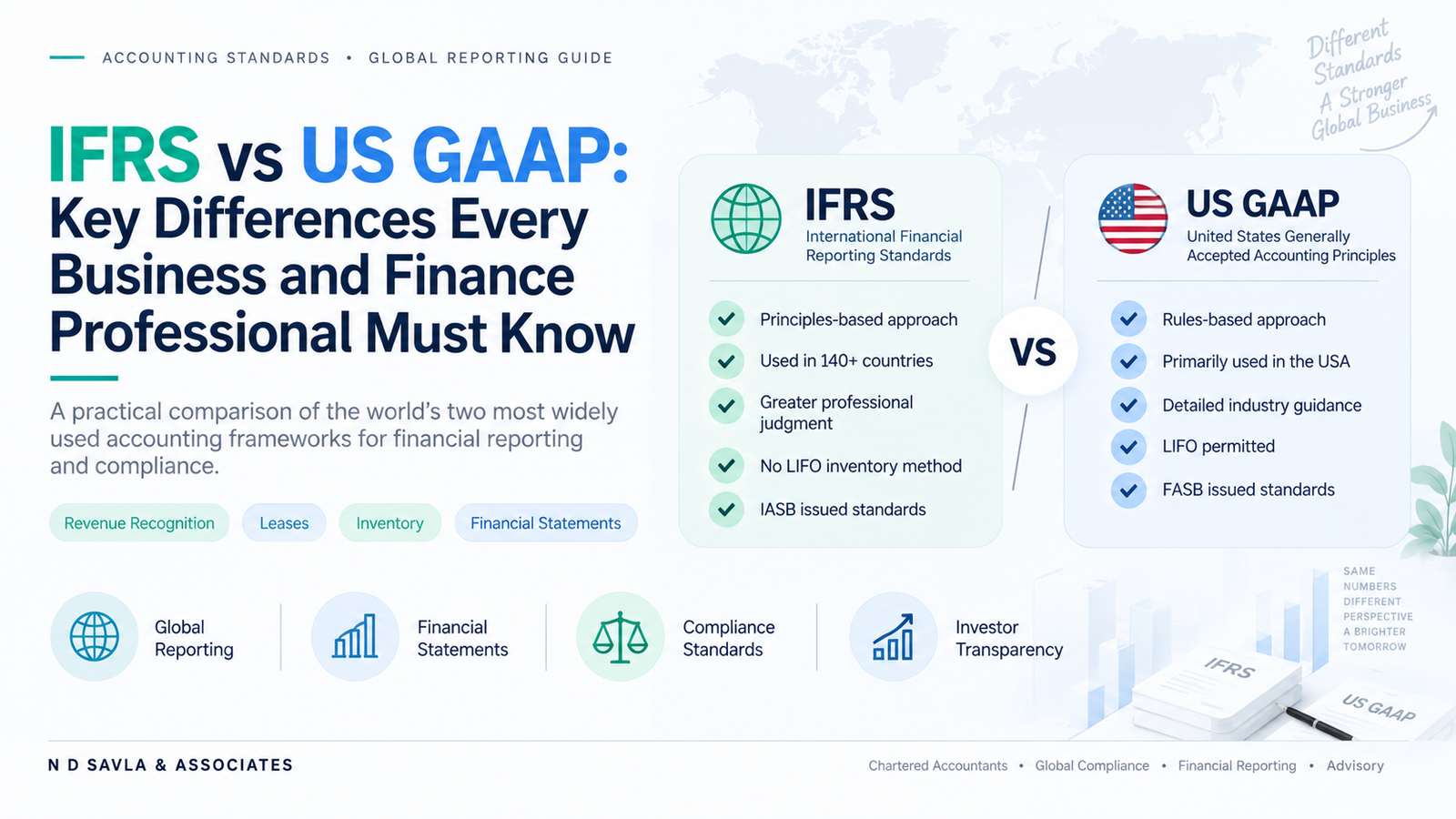
IFRS vs US GAAP: Key Differences Every Business and Finance Professional Must Know Accounting & Financial Reporting IFRS vs US GAAP: Key Differences Every Business and Finance Professional Must Know Understand the critical differences between IFRS and US GAAP across revenue, leases, inventory, R&D, and impairment — and what they mean for Indian businesses. By N D Savla & Associates | September 1, 2026 | 19 min read Home/Blog/Accounting & Financial Reporting/IFRS vs US GAAP Differences IFRS vs US GAAP matters to Indian businesses in a way it did not a decade ago. India’s adoption of Ind AS — converged with IFRS — means that Indian financial statements already follow IFRS principles. But the moment an Indian company becomes a subsidiary of a US multinational, lists on a US stock exchange, enters a cross-border acquisition, or operates a Global Capability Centre processing accounting for a US parent, the differences between IFRS and US GAAP become a daily operational reality. These differences are not theoretical — they change reported revenue, asset values, EBITDA, and net profit. An Indian pharmaceutical company that capitalises development costs of ₹50 crore under Ind AS (following IFRS) will report those costs as an expense under US GAAP, reducing its US GAAP profit by ₹50 crore in a single year. An Indian manufacturer using weighted average inventory will report different cost of goods sold if the US parent applies LIFO. An Indian company applying IFRS 16’s single lease model will show different operating profit than the same company under ASC 842’s dual model. N D Savla & Associates, a Chartered Accountant firm in Mumbai, provides accounting advisory services that cover both IFRS and US GAAP frameworks for Indian businesses operating in cross-border environments. Why Does the IFRS vs US GAAP Comparison Matter Specifically for Indian Businesses? The IFRS and GAAP comparison is not an academic exercise for Indian businesses — it affects four specific and increasingly common scenarios in the Indian corporate landscape. Indian Subsidiaries of US Multinationals Over 1,700 US multinational corporations operate subsidiaries in India. Every quarter, these Indian entities prepare US GAAP reporting packages that are used by the US parent for group consolidation and SEC reporting. The Indian subsidiary maintains its statutory books under Ind AS (converged with IFRS), but the reporting package must be converted to US GAAP — requiring identification and quantification of every Ind AS and US GAAP reconciliation adjustment. Revenue recognition timing differences, lease classification differences, development cost treatment, and inventory valuation methodology all generate conversion entries. The accuracy of these entries directly affects the US parent’s consolidated financial statements, which are subject to SEC scrutiny, SOX compliance, and external audit. Indian Companies Listed on US Exchanges Indian companies listed on NASDAQ or NYSE — including technology, pharmaceutical, and financial services firms — file annual reports on Form 20-F with the SEC. Foreign private issuers may file using IFRS (as issued by the IASB) or US GAAP. If an Indian company files using IFRS, it must ensure compliance with pure IFRS — not Ind AS, which contains carve-outs. If it files using US GAAP, the full framework conversion from Ind AS to US GAAP must be executed to SEC standards. Cross-Border M&A and Joint Ventures When an Indian company acquires or merges with a US company — or vice versa — the due diligence process requires reconciliation of financial statements across frameworks. Purchase price allocation, earn-out calculations, and post-merger integration all depend on which framework’s numbers are used. An asset valued at ₹100 crore under IFRS (where development costs are capitalised and impairment reversals are permitted) may be valued differently under US GAAP (where those costs are expensed and reversals are prohibited). Transfer pricing arrangements between Indian and US entities must also reference the correct framework’s profitability metrics. Global Capability Centres (GCCs) and Shared Service Centres India hosts over 1,700 GCCs — captive centres that process finance, accounting, and reporting functions for global parent companies. A significant share of these GCCs process US GAAP accounting for US-headquartered groups. The Indian finance professionals staffing these centres must understand US GAAP rules — ASC codification, revenue recognition under ASC 606, lease accounting under ASC 842, credit loss provisioning under ASC 326 — even though their statutory Indian training is in Ind AS and IFRS. For CA firms advising GCC operations, competence in both frameworks is a competitive necessity. How Do IFRS and US GAAP Differ in Their Approach to Standard-Setting and Professional Judgement? The most fundamental IFRS vs US GAAP difference is not about any single accounting treatment — it is about how the two frameworks approach the task of creating accounting rules. This philosophical difference shapes every standard, every application, and every audit under each framework. IFRS, issued by the International Accounting Standards Board (IASB), is a principles-based framework. Standards establish broad principles and objectives, and preparers apply professional judgement to determine how those principles apply to specific transactions. When IAS 38 (Intangible Assets) requires capitalisation of development costs when six criteria are met — technical feasibility, intention to complete, ability to use or sell, existence of future economic benefits, availability of resources, and ability to measure expenditure reliably — the preparer must exercise judgement on whether each criterion is satisfied. There is no numerical threshold, no percentage test, and no bright-line rule. The auditor evaluates whether the preparer’s judgement was reasonable, not whether a specific test was passed. The Institute of Chartered Accountants of India (ICAI) trains Indian CAs in this principles-based approach through the Ind AS framework. US GAAP, issued by the Financial Accounting Standards Board (FASB), is a rules-based framework. The Accounting Standards Codification (ASC) provides detailed, specific guidance — including numerical thresholds, decision trees, and scope exceptions — for virtually every transaction type. Where IFRS says “exercise judgement,” US GAAP says “apply this test.” This reduces diversity in practice and provides legal defensibility in the litigation-heavy US environment, but it also enables structuring — designing transactions to meet or avoid specific thresholds without necessarily reflecting